Sunday, March 29, 2009

Abroad... maybe two


I've lived in Southern Indiana all of my life. I was born in Deaconness Hospital in Evansville and I've pretty much always lived in the Evansville area. Being an energetic and restless teenager, you can imagine my excitement when I finally decided -- after much and difficult deliberation -- that I would be attending the University of Southern Indiana. Whooo freakin' hooo.

It was a big move, packing up all of my stuff in the car and driving the eight-mile trek from home to the university. Needless to say, Mum and Pop were pretty hesitant to leave me away at college and drive back to their empty nest. Actually, now that I'm thinking about it, they didn't even come help me move in, probably because they knew it would be an emotional parting.

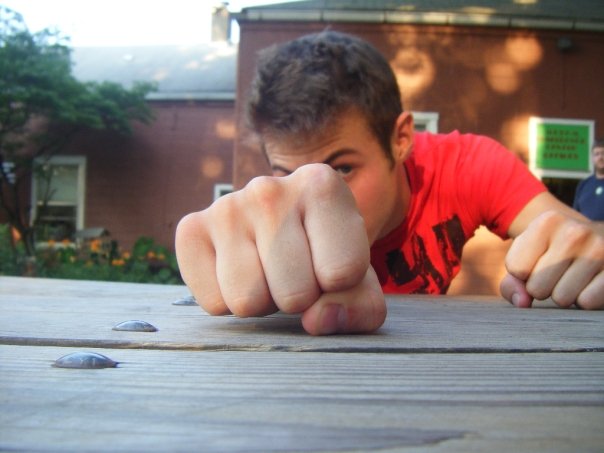
If you haven't picked up the sarcasm by now, you're probably dead, so you can go ahead and stop reading now. If you're still with me, shoot a quick glance at the pretty pictures (which, by the way, were taken from another website... probably illegally) and then keep reading to find out where they came from.

I think it's about time to get out of Southern Indiana for a while, see the world, you know... do all of that stuff young people are supposed to do.

So I'm working on going to Australia. I'm thinking this is going to be a study abroad trip to the University of Wollongong (think about how sweet those t-shirts are going to be!) during the spring of next year, which means that a year from today, I will be learning to surf in the South Pacific Ocean.

The Australian semester doesn't start until February, so let me tell you my plan that will surely be struck down once my mother gets wind of it. I'm going to sell my car (I won't be using it much) and leave the day after Christmas to head down there. I'll spend New Year's Eve watching fireworks on the Brisbane River with some beautiful Australian girl that I plan on meeting at the airport. Sometime New Year's Day, I'll find Crocodile Dundee, preferably still drunk from the night prior, and buy a motorcycle from him for cheap. Depending on how the evening went, I may take my beautiful Australian girl with me when I ride the motorcycle in a general southwesterly direction. At this point the sun will be setting, and, if shot from the right direction with the right lens, this will make a great photograph, which I will plan on uploading to this blog as soon as I find an internet connection, which may not be for a while.

I'll drive my motorcycle through the night into Outback, take out an order of two Bloomin' Onions, and then keep driving until I get to the Outback. When I get tired, I will lay down a few feet from the road and fall asleep covered in Off bug spray and looking up at the stars. The constellations and the moon will all look different and I'll fall asleep and dream of my toilet back home, which flushes counter-clockwise instead of clockwise.

By the time I get to where I'm going (the Aboriginal village), the sun will most likely be setting on the next day. I'll take my shirt off to show off the traditional body paint that my new Aborigine friends will give me. We will sit around the fire exchanging stories and smoking something hallucinogenic until we all fall over laughing except for the one guy screaming about green dragons in the corner. Of this part of my journey, there will be no pictures, partly because Aborigines don't like it when you take pictures of them, and partly because I don't want any future employers to see me doing drugs.

I'll spend the next month doing much the same thing, but I won't go into details because I actually want people to read my blogs for once rather than looking at them longingly before deciding on something better to do. Eventually, I'll end up studying Psychology at Wollongong, where I will spend a lot of time hiking, surfing, swimming, and introducing the sport of free running to the good people of the Gong. Can't wait.


Reflections

Although the title of this blog sounds like it could be Evansville's next phone dating service, this piece is, in fact a short collection of reflections on the past however-many-months-it-has-been-since-September. If you play your cards right, you might even convince me to push my reflections back all the way to August.

Ok you've got me convinced. I guess the story really begins way back in May of last year. Well, while we're being honest about things, the story really begins in January of 1990 (you might even be able to say that it started nine months before that, or six years before that, when my parents were married, or in 1977 when they met, but we won't push it all the way back to '62 when they were born because that would be just too much), but the only part that matters for this assignment started in May.

By May, I had decided after a long and difficult decision-making process that USI was the college for me. That process nearly ended up at Indiana Wesleyan University instead of here (I actually had already been offered and accepted an on-campus job there when I made my decision), but it's too long of a story to tell without having to publish an abstract or summary to go with this blog.

The summer went by slowly, with the biggest highlight being the... interesting... three weeks that I spent in Michigan volunteering my toilet-cleaning skills at a Young Life camp. Then came a bunch of sitting around the house, and finally it was time to move in. I don't think that it is an understatement to say that Welcome Week was the shizzle-fizzle-bang-bang. It was everything good about college life jammed into one week, and the whole thing was completely homework free. In case you were wondering, I don't count intoxicated partying among the good things about college, so don't jump to any conclusions about me. I don't do that stuff.

Eventually, though, my romantic affair with welcome week came to a halt and my old mistress, mundanity, caught up with me. School had started and I found that it was a lot like high school, except I had more free time and the intensity of the weird people I met and the weird stuff that happened to me was cranked way, way up. I guess when some people go off to college, they feel like they no longer have to keep the fact that they are complete psychopaths under wraps, like they are just suddenly allowed to be as screwed up, lazy, suicidal, stupid, or crazy as they wanted to be in the interest of "self-expression." Now, I'm all for self-expression, but there are times when you just need to sort of try to be human for a while, you know?

I kicked off the year the right way by inadvertently getting involved in two relationships (one was platonic, the other was what some would call romantic), which turned out to be two of the biggest mistakes of my life. Coincidentally, both of those people's names started with the letter "J," and I hope they don't read this because I think they would immediately know who they are and would probably not be too happy with me. To my friends whose names start with "J:" it's nothing against you personally; it's just that you weren't right for me. At all.

Anyway, the rest of the year was pretty straightforward. I spent some time vacillating between having no idea what I wanted to do with my life and knowing that I didn't want to stay in Comm. Studies, before finally deciding, quite happily, on Psychology for a major. I pretty much did all of the typical college stuff (no... not that college stuff): got up, went to class, did homework, hung out with friends, made midnight trips to Wal-Mart, cooked out, hung out of windows, et cetera. That college stuff. I had a fleeting Storgic romance that ended as peacefully as it had begun (thankfully, not one of the biggest mistakes of my life), and from that made a great friend.

I took Geology lab at 9:00 am and a bunch of classes in the major that I don't want to be in (Comm. Studies), which collectively make me want to hurt cute animals or chop up pillows with a knife or something, but this semester only sucks two days a week, so I'm holding in there.

All in all, pretty good year. Lived. Learned. Laughed. Loved (platonically, of course). College.

Shoot... I think this is going to need an abstract...

Sunday, March 22, 2009

Epitaph for a ticker (Welcome to my stream of consciousness)

Sometimes I wonder if it is cheating to use papers that I have written for other classes as blog posts for HONS. I can just about self-justify it by telling myself how interesting the papers were for me to write, imagining how relevant the subject matter may be to an HONS class setting, and, of course, reminding myself of the excellent marks that I received the first time I turned the papers in for credit. However, based on the last 1500-word essay that I posted (from CMST 107, for which I received an A+), I have come to the conclusion that nobody wants to read my extra-long prefabricated posts... or at least I know that I wouldn't.

As I think about it more, I also seem to recall something about how at least one of our blog posts each week is supposed to be about a current news event. This has become a lot more difficult since my news ticker (may God rest its soul) has apparently stopped ticking news, and, being the heartless utilitarian that I am, I promptly and unceremoniously tossed the thing into my virtual recycle bin, my own little digital Island of Misfit Toys. I dug it up just to check to see if it was working again (it was under the electronic jigsaw puzzle with the missing piece and my double-amputee Habbo avatar) and the last story that is posted to it is from February 21, annoyingly still telling me that The Love Guru won some awards for sucking at the Razzis; it is a story that I didn't care about the first several times that I saw it.

It must be some dark side of the economic crash: the guy who was in charge of ticking my ticker was either downsized or killed in a mugging. I'm going to miss that guy... or possibly that lady. He or she was a wonderful man or woman, full of vivacious energy, well-versed in computer sciences, and able to type large words without looking down at the keyboard. He or she always made me laugh with his or her comical headlines, and was constantly pulling practical jokes on me (generally it was disguising sports news which I care nothing about under a headline that appeared to be much more interesting than it really was).

I can't stop myself from thinking, "What if?" What if there had been no mugger to steal his or her wallet and accidentally pull the trigger on the revolver in an escape to get away from the scene of the crime, inadvertently hitting he or she in the lower femoral artery with a nine millimeter bullet? What if the mugger had not lost his silicon valley job and retirement to the plummeting economy? What if the mugger's house had not been foreclosed on because he had insisted on buying beyond his means to try to provide what he thought was a good life for his family? What if the tall woman at the bank had not approved the loan to the mugger that allowed him to buy that new Lexus but eventually led to his downfall? What if the banker had not drank so much coffee that morning? What if the legislation prohibiting risky loans had not been repealed? What then?

Maybe then my ticker technician would still be with us today and I wouldn't have to keep reading about the gosh-darn Razzies until kingdom come. Think about it.

Gone But Not Forgotten (or Here But Not Remembered)

In one of Plato’s dialogues, Meno, Plato presents his view of the origin of human knowledge. He believes that all knowledge is contained within each eternal soul, and knowledge comes simply by recalling the knowledge that is already there. This is a view that was held by many philosophers after Plato, all the way down to Descartes , Liebnez, and even more recent thinkers. I seek to argue that this theory, which is referred to as the recollection theory of knowledge is not reasonable or true and that the common arguments and examples used as evidence of a priori (“that which is prior to the first”) knowledge are not valid. Then, I will present an alternate theory of knowledge to fill the void left by the recollection theory.

Plato believed and taught that knowledge is not something new to be discovered, nor is it something which must be taught. Rather, knowledge is something that resides already within us and needs only to be discovered and remembered in order for that which is traditionally called “learning” to take place. The first example (to my knowledge) that was used as a proof for the recollection theory of knowledge was provided in Plato’s dialogue Meno, in which Socrates coaxes an uneducated slave boy into knowledge of geometry, using only a series of questions to elicit the knowledge that he already knows. The argument that stems from Socrates’ demonstration with Meno’s slave is as follows:
1.) The boy does not know how to double the area of the square before starting,
2.) He is not explicitly taught any new knowledge about the process of doubling the area of a square.
3.) He successfully finds out how to double the area of the square.
4.) Therefore, he must have an innate knowledge of geometry.

However, a closer inspection of Socrates’ method of “eliciting recollection” in the boy reveals that one of his steps of teaching arguably violates the rule prohibiting explicit teaching. At one point, after the boy fails a few times, Socrates draws three more squares that are identical to the first square to make a square that is quadruple the area of the original, then proceeds to connect the mid-points of each side of the large square, bisecting each of the four smaller squares to make one square that is half of the area of the four combined squares, or double the area of the original square (Plato 85b). This is an idea that the boy was not likely to have come to on his own; neither would he have sprung upon this idea as a result of any series of non-explicit questions. Socrates’ teaching strategy here was about as explicit as it possibly could have been (he literally took the stick into his own hand and showed the boy how to do it). It is at this point that the original argument for innate knowledge falls apart. In the enumerated argument above, this violates premise two, that the boy is taught nothing explicitly, and the argument is no longer sound. This slave boy did not know this geometric truth (essentially the Pythagorean Theorem) until he was shown explicitly and experientially one of its uses.

It is doubtful that even Pythagoras himself came up with this theory without first finding some sort of empirical data upon which to base it. To say that modern science, mathematics, and basic truth have existed in the human mind since the beginning of humanity, and have been lying around docile just waiting for someone to ask the right questions to discover them is foolish. The science of genetics, could not have been founded on anything other than Mendel’s experiment; otherwise it would have been speculation rather than science. Likewise, Darwin’s theory of evolution did not come from innate knowledge awakened by the question, “Where did we come from?” but rather from his observations and careful studies of real organisms on an island. The anticipatory thought that preceded these sciences could be said to be the result of experientially inspired questions and critical thought based in reason. Even ancient mathematical truths, which Plato would attribute to the truth and universality of his forms, are made true rather by the fact that they are backed up by empirical fact (5+7=12 not because we know the form, but because we have seen that five apples added to seven apples makes twelve apples). That which we know is based on what we have learned to be true through experience or empirical data.

One other problem that I find with Plato’s argument is that he assumes that innate knowledge is the only explanation that can be given for the boy’s ability to double the area of the square. A more reasonable and simple alternative would be that the boy was able to demonstrate proficiency in geometry because of his human ability to reason and figure things out for his own. By Occam’s razor, the more reasonable conclusion is that he did not have to appeal to some innate knowledge in some dark corner of his soul; he only had to appeal to the human powers of deduction and induction, using what he could see with his eyes, definitions (which he knows from being explicitly taught language), and a perceptive assessment of the direction that Socrates’ questions were pointing to come into his own correct understanding of the driving geometric truths (forms, if you will) behind the problem.

Knowledge is a product of experience. Every single aspect of what is recognized as truth holds, as its origin, some experiential basis. Even if we were to believe that human knowledge was inherent in the soul, what would be to keep that knowledge from being inherently false? How are we to know that the knowledge in our soul is anywhere close to true? Reason tells us that there is no way of knowing that, so we must rely on our experience and our senses to be our source of truth.

Now, it would be quite easy for an opponent to ask the question, “How do we know that our senses can be trusted as a source of truth?” The question raises a good point; anyone who has ever seen an optical illusion or magic show can tell you that our senses often cannot be trusted, and they can quite easily be manipulated and tricked. This certainly makes it difficult to say that sensory experience is a source of absolute truth. To this I have no reply. There is indeed no way of knowing when our senses tell us the truth and when they lie. We assume things like “The sky is blue,” because that is what our senses tell us, but what if we have been tricked since our birth into believing that the sky is blue, when it is really some shade of burgundy, or what if one person’s perception of blue differs from another’s, and it just so happens that we call the same object “blue” while seeing entirely different hues? We cannot know.

So now the question becomes, “What can we trust?” We clearly cannot trust our senses as a source of knowledge, and we cannot, of course trust the “innate knowledge,” unless we know first that it exists (which is not provable), and where it came from (which is not findable). This is a dilemma that would certainly seem to throw a wrench in the cogs of our search for the source of knowledge. At this point, we could return to Descartes’ “I think, therefore I am,” statement and simply settle to leave the extent of our knowledge to be that of existence and nothing more, which is not exactly a happy day for epistemology. Rather, I would like to present an idea that is perhaps not quite so intellectually satisfying as one may wish, but will [I hope] at least provide us with a practical compromise as to the knowledge that we can trust.

We know that, regardless of whether or not we hold innate knowledge (right or wrong), the only way in which any new information enters our body is through the senses (Locke’s “Doors of Perception”) and sometimes through the creative churnings of the mind. News of any action which we do or which affects us enters the body through the senses. The only truth that matters then is truth that, when applied to the world, remains true as far as the senses can tell. This is, of course, an idea which is based entirely on utility. If it is true to the senses and it is practical in the world, and if the utilization of a piece of knowledge returns sensory information that is consistent with whatever hypothesis may stem from that knowledge, then the knowledge is true as far as man is concerned or can be concerned.

As an example, I would return once again to Pythagoras. Suppose that Pythagoras wants to build a bridge out of a single piece of felled timber to span the width of a river. Pythagoras finds a large tree, measures the distance from the base of the tree to the spot at which he is standing, measures the angle at which he must look up to see the top of the tree, and uses his mathematics to calculate that the tree is, in fact, tall enough to span the gap. He has some workers cut it down and lay it across the stream. If he then measures the tree, his calculations were correct, and he sees that the tree is tall enough to span the gap, then the knowledge that he used as a calculator must be practically true.

We can know what our senses are telling us. We may not know whether they are telling us the truth or not, but as long as they continue to tell us what is consistent with the knowledge that we use, it makes no difference. Truth is that which unifies our senses and our reason, allowing us to perceive what we think we should perceive. Beyond that, we cannot know for certain what is true and what is not true.

Monday, March 16, 2009

Back2Grind

Hey everybody! Welcome back to school. I hope you all enjoyed your spring break, but I'm sure it was tough on you being away from your studies. The good news is that we're all back and we can get back to learning. You know that your education is one of the most important things that you can get in your life. Just know that you had better enjoy yourselves for the next eight weeks, because after that, we have to take a break from our learning for a few months. Enjoy it while you can! Welcome back to the grind!

Friday, March 6, 2009

A beautiful spring day

I don't think it needs to be stated that today is, in fact, the advent of our spring break. While I don't have any grande or illustrious plans for break, the wonder and beauty of the event of spring is certainly not lost on me. Spring is my favorite season of the year. I used to be quite fond of winter, but then I came to college and had to walk several miles through the cold each day, and that particular season quickly lost its appeal. Spring, on the other hand is the perfect season. The world gradually shakes off the cold that has covered the last few months, bringing us into the perfect temperature and weather. Everything begins to grow again (including the window garden that I planted in honor of the season), and people with Seasonal Affective Disorder finally stop complaining all the time.

Everyone enjoy your spring break, have fun, and don't do anything that will likely result in your death. Peace!

PEDe-stress

I don't think we ever really appreciate how good we really have it here at USI. We've got the lowest tuition in the state, the nicest residences in the history of college, great programs, new buildings, state-of-the-art technologies, and of course a metric buttload of awesome PE classes to take. Last semester I took a rock-climbing course, getting college credit for a sport that I love, while getting a lot of good practice and coaching, exercise, and a semester's worth of essentially free membership to the climbing gym. That's a sweet deal.

This semester, I enrolled in yoga, even though I already have all of the PE credits that I need. I did it partially as a joke, and partially because I think it is cool, but mostly because it is a lot of fun. I can honestly say that yoga class is one of my favorites. It gives me a chance to get in exercise (which I rarely do on my own) and gives me a shot at de-stressing when the weeks get long and I get fed up with some of my classes. As an added bonus, I get to learn yoga, which is great for providing entertainment at parties. Usually after class, I grab the first couple of people that I see and show them all of the wacky stuff that we did in class. One of my most commonly heard phrases is, "Guess what we did in yoga today!"

I guess the moral of the story is just that sometimes we need to kick back and take some fun classes or do some exercise or just enjoy the time that you have. Kick back and relax or get some exercise, or just do anything but schoolwork all the time. Your brain will thank you, and your schoolwork may even improve a little bit if you relax a little bit.

Namaste.

Tuesday, March 3, 2009

Lost in Transl8shun

It is no secret that over the last few decades, the world of communications has been revolutionized by the advent of several new and innovative technologies (which I will herein collectively refer to as “NewComm”). Those technologies – most notably cellular phones, e-mail, text messaging, and social networking websites – have turned the communications arena into a fast-paced, nonstop, instant access, and sleepless world. Businesses have restructured to accommodate the new technologies, and individuals have allowed their entire lifestyles to change. These technologies have allowed us to successfully and boldly go where communication could not go before, but that luxury comes with a price. Because of our growing dependence on electronic communication, people are losing their ability to communicate effectively and traditional communication skills are fading away. Although NewComm tools provide us with an easy, fun, and versatile way to communicate, there are also several serious drawbacks to their use, and we need to be exceedingly careful in how we use them.

It’s easy to see why NewComm technologies have become so popular. We live in a culture that is obsessed with speed – getting as much stuff done in one day as possible. NewComms provide us with a quick way to communicate. E-mails and text messaging allow us to quickly and reliably send messages to anyone anywhere. Facebook, Myspace, and other social networking websites put all of our friends in one place at our fingertips, and contacting them is just a few clicks away. NewComms give us an efficient and cost-effective way to speechify at each other at any time that we please.

Another strength of NewComms is that they are extremely versatile. As communications technology advances, people are finding it increasingly easier to engage in communications in times and situations that they would have previously found it at least difficult, if not impossible to communicate in (Snowden 113). For instance, many students are finding that it’s quite easy to use text messaging services in class, to continue or initiate conversations that are normally not permitted in a classroom setting. I can’t even count the number of times that I have seen students checking their e-mails or facebooks during class trips to the computer lab. Traditional communication etiquette states that it is poor manners to call someone on telephone after a certain hour of the night, for fear of waking up the whole family, but thanks to cell phones, it’s now perfectly acceptable to make a call at any hour of the night and get a hold of exactly the individual that you are trying to contact, without having to talk to an angry mother.

Some technologies (namely e-mails and text messages) provide the added bonus of being able to keep the messages that are sent to you in an electronically stored format. This allows you to refer back to messages at a later time (like having a built-in stenographer) or to keep particularly sappy or meaningful messages as keepsakes (Snowden 113).

With these and many other apparent “pros,” it’s easy to see why so many people are so enamored with NewComm technologies. Unfortunately, many people allow their enjoyment of these technologies, particularly text messaging and online social networking, to turn into a full-blown addiction that borders on a diagnosable condition (Snowden 113). I personally know many people who spend hours each day sending and receiving text messages (as many as a few thousand per day) or browsing through facebook or Myspace. I have talked to people who literally believe that they are incapable of living without a cell phone, and the number of people who are willing to interrupt a face to face conversation with a phone call or text message is quickly becoming a rude majority.

Along with addiction to communications technology, heavy users face many other problems that result from their NewComm dependence. Classical communications skills are deteriorating as formal modes of communication lose popularity and less emphasis is culturally placed on the importance of clarity, spelling, and grammar. People are becoming more and more dependent and used to using the crippled and simplified language that is commonly used in text messaging and e-mails (txt), making it impossible to pick up on nonverbal messages and linguistic subtleties that exist in real, face-to-face communication. Using simplified text forms of communication, we are unable to perceive the impact and emotions that come with the message, and are therefore incapable of really getting to know the people we are interacting with. (Hanson 92).

Each developed language in the world has four basic skills that are required for truly effective communication: listening, speaking, reading, and writing (Vethanayagam). When we use digital text communication, both listening and speaking are out of the picture, and unless we take very great care when composing and interpreting the messages being sent, reading and writing can take a big hit as well. So, without speaking or listening, or even functional versions of reading and writing, what sort of language are we left with? We are left with a broken language that has shed much of the meaning and emotion that is apparent in traditional communication. Digital text messages (in e-mail or text message form) provide for us an easy way to give ourselves the illusion of having communicated well, when in reality all we are doing is confusing the messages and frustrating the communicators (Duffy). Snowden speaks of the language of text messaging as a language that “… requires the disruption and manipulation of conventions of grammar and syntax” (Snowden 114).

In addition to replacing the traditional rules of spelling and grammar with a short-handed chicken-scratch sort of pop culture language, our text-message culture is losing touch with the true meanings of many of its words and phrases, and likewise replacing them with condensed or butchered versions. It is this sort of language that John Powers refers to as “lazy English,” the use of euphemisms, idioms, and words even when we don’t know their true meaning (A Loss for Words). For instance, the common phrase, “The proof is in the pudding,” is a botched, nonsensical variation of the proverb, “The proof of the pudding is in the eating” (A Loss for Words). Our culture is losing touch with its communication values. Admittedly, one would be hard pressed to draw the line connecting text messaging to the deterioration of English proverbs, but the fact remains that our language as a whole is slowly falling into a state where definition is giving way to efficiency; our entire language is becoming a shorthand shadow of itself.

Some consider the dialect that is spoken in text messages (a language called “txting”) to pose a direct threat to the educational futures of students, citing examples in which schoolchildren have turned in entire essays written in txt shorthand (Carrington 170). In response to the question, “What did you do over summer break?” the following essay was turned in by a thirteen-year-old female student in Scotland:
“My smmr hols wr CWOT. B4, we used 2go2 NY 2C my bro, his GF & thr 3 :- kids FTF. ILNY, it’s a gr8 plc.”

She was trying to say, “My summer holidays were a complete waste of time. Before, we used to go to New York to see my brother, his girlfriend, and their three screaming kids face-to-face. I love New York, it’s a great place” (Carrington 161). It’s easy to see why teachers would consider this language to be a threat to the education of their students. For starters, unless you are knee-deep in the muck of popular culture, that sort of essay is going to look like a bunch of garbled letters, or at least like some sort of code. It would be completely illegible to a teacher that is used to traditional English writing, which makes it quite difficult to grade, especially if there is a grade for grammar and mechanics. Some have linked the language of txting to a “literary crisis” in individuals and educational institutions (Carrington 171).

The question now becomes, “What can we do?” Obviously, no one wants a “literacy crisis” on their hands, and most reasonable people would agree that it’s generally not a good thing when the language you are using falls apart under your feet. If that were to happen, we would all have to learn to speak German or something, and I personally don’t think I have the salivary glands to handle that. However, the solution is not so simple as getting rid of NewComm technologies, and going back to the “good old days.” NewComms have already been woven too deeply into the fabric of our culture to simply throw them out. But, we must be exceedingly careful in our usage of them. We must monitor ourselves in our communication, to make sure that we communicate with integrity. We must make sure that the messages we send can be well understood by the people that we are sending them to. We must keep a sharp eye on how we use NewComm technologies like social networking sites and chat rooms, and be aware of the dangers associated with them (Carrington 170).

In the end, it’s not enough to whine and complain about the adverse effects that modern communications technologies are having on our society, and it’s not possible to throw them out. As they are now, these technologies are partially responsible for a deterioration in the language that we use, but we as users are just as responsible. We need to be conscious and aware of how we use NewComms in our lives, and make sure that we don’t allow modern computer-mediated technology to take over the good old fashioned kind. Our language is in trouble, and only you can do something to save it.


Works Cited
Carrington, Victoria. "Txting: the end of civilization (again)?" Cambridge Journal of Education 35 (2005): 161-75. Communication and Mass Media Complete. EBSCO Host. David L. Rice Library, Evansville, IN. 27 Feb. 2009 .*
Duffy, Michael. "Why your lazy e-mail habit is bad for business." Advertising Age 26 Nov. 2007: 24-24. Communication and Mass Media Complete. EBSCO Host. David L. Rice Library, Evansville, IN. 27 Feb. 2009 .
Hanson, Jarice. 24/7 How Cell Phones and the Internet Change the Way We Live, Work, and Play. New York: Praeger, 2007. 92.
Powers, John. "A Loss for Words - The Boston Globe." Boston.com. 8 Feb. 2004. The Boston Globe. 27 Feb. 2009 .
Snowden, Collette. "Cstng A pwfr4l spLL: D evOLshn f SMS (Casting a Powerful Spell: The Evolution of SMS)." The Cell Phone Reader: Essays in Social Transformation. Vol. 34. New York: Peter Lang, 2006. 113-15.
Vethanayagam, S. Anand Lenin. "Internet Usage and Its Effect on Reading Skill among the College Students - A Case Study of Coimbatore Region." Language in India 8 (2008): 1-1. Communication and Mass Media Complete. EBSCO Host. David L. Rice Library, Evansville, IN. 27 Feb. 2009 .*